| Current Research of Zhigang Peng's Group |
Back to Zhigang Peng's Homepage
The research conducted by our team focuses on understanding spatio-temporal evolutions of active faults and the physics of earthquakes, based on stematic analysis of large seismic data sets. Our research topics include: |
High Resolution Imaging of Fault Zone StructuresNatural earthquakes occur on geological faults. An accurate determination of fault zone properties at seismogenic depth has important implications for many aspects of earthquake physics. Damaged fault zone rocks with high crack density are expected to produce several indicative wave propagation signals. These include scattering, intrinsic attenuation, anisotropy from cracks or fault zone properties, non-linearity, reflections associated with prominent impedance contrasts, and fault zone guided head and trapped waves. These signals can be used to obtain high resolution imaging of the subsurface structures of fault zones and to track possible temporal evolution of fault zone material properties.Results associated with systematic analysis of such signals at several large strike-slip fault zones can be summarized as follows: The observed fault zone trapped waves at several fault and rupture zones are generated by relatively shallow structures that extend generally only over the top ~3-4 km of the crust [ Ben-Zion et al., GJI, 2003 ; Peng et al., GJI, 2003 ; Lewis et al., GJI, 2005 ]. The shallow trapping structures are characterized by about 100m-wide fault zone layers with strong reduction of seismic velocity (e.g., 30-40%) and strong attenuation (e.g., Q values of 10-30). The shallow trapping structure in the North Anatolian fault is surrounded by broader anisotropic and scattering zones that are also confined primarily to the top 3 km [ Peng and Ben-Zion, GJI, 2004 ]. The shallow structure responsible for generating both fault zone trapped waves and anisotropic effects may be related to the top part of a flower-type structure of the fault zone. It contains highly damaged materials with intense microcracks and resides above the active portion of seismogenic crust where earthquakes nucleate. Such structure significantly increases the seismic shaking hazard near the fault zone, since seismic sources external to the fault zone are capable of generating strong motion amplification in the shallow trapping structure.

~18000 earthquakes recorded along the Karadere-Duzce branch of the north Anatolian fault after the 1999 Izmit and Duzce earthquakes in Turkey. The rest panels show subsequent analysis of fault zone signals based on this data set [Ben-Zion et al., 2003, 2007; Peng and Ben-Zion, 2004, 2005, 2006]. Our recent work in this direction focuses on using fault zone head waves (FZHW) to image the fault interface at seismogenic depth. Major plate boundary faults such as the San Andreas fault often juxtapose blocks with different elastic properties. A sharp material contrast is expected to refract seismic energy along the interface, generating emergent first arriving waves with opposite polarity from that of the following direct P waves that are recorded by near-fault stations on the slower block. Systematic analysis of near-fault data along the Calaveras fault [ Zhao and Peng, GRL, 2008 ] and Hayward fault [Ohlendorf et al., in prep.] in northern California, and around the Parkfield section of the San Andreas fault [Zhao et al., in prep] in central California have found clear FZHWs in each segment, with velocity contrast ranging from 2 to 15%. Our next step is to perform detailed waveform analysis of FZHW to obtain high-resolution information of fault zone structure at seismogenic depth.
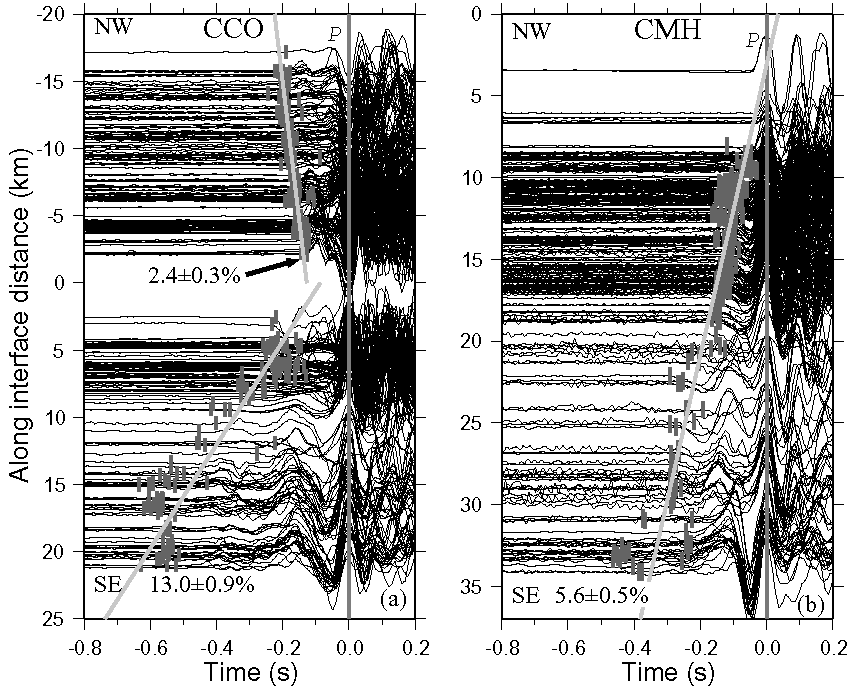
Stacked traces at stations CCO and CMH around the Calaveras fault showing the moveout of the fault zone head waves [Zhao and Peng, 2008]. |
Temporal changes of the Earth's propertiesMeasuring temporal changes in material properties has been a long-sought goal in seismological community for many decades. Our previous studies [e.g., Peng and Ben-Zion, GJI, 2005 ; Peng and Ben-Zion, PAGEOPH, 2006 ; Zhao and Peng, in prep.; Peng et al., in prep.] together with others based on analysis of repeating earthquakes and artificial sources, have found small but observable changes of seismic velocities in shallow surface layers and around active faults, with rapid reductions during strong motions of nearby large earthquakes, followed by logarithmic recoveries. These results provide strong support that damage, or nonlinearity, is widespread in the shallow crust during strong shakings, and may help to explain fault interaction and earthquake triggering by seismic waves. The use of repeating earthquakes allows the separation of temporal changes of material properties from spatial variations of earthquake locations. However, repeating earthquakes only exist in certain regions, and there is no control on their occurrence. Studies that employed repeating artificial sources are limited by high cost and poor depth penetration.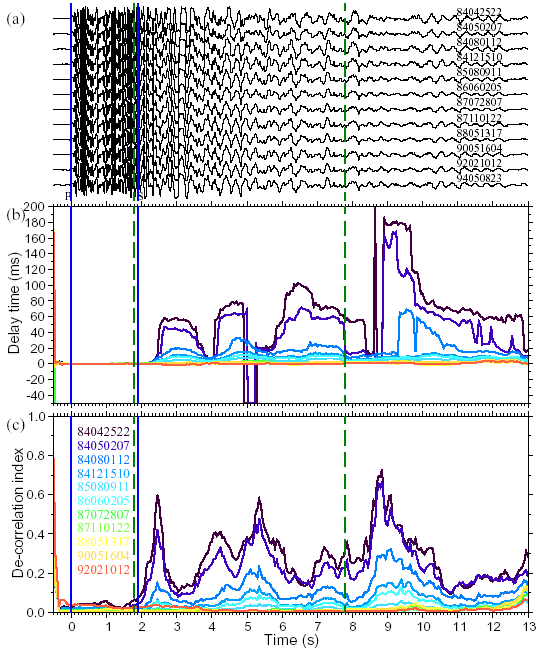
Waveforms generated by repeating earthquakes showing temporal changes after the 1984 M6.2 Morgan Hill earthquake [Zhao and Peng, in prep]. Recent developments in passive imaging via auto- and cross-correlation of ambient seismic wavefields (e.g., seismic noise, earthquake coda waves) provide an exciting opportunity for mapping spatio-temporal variations of the Earth’s properties with unprecedented resolutions. The basic idea is that cross-correlation or deconvolution of diffuse seismic wavefields recorded at two stations results in the Green’s function between them. Because ambient wavefields exist at all times in many regions, they provide an ideal source for continuous monitoring of temporal changes in the upper crust. Currently we are developing multi-scale passive-imaging techniques to observe temporal changes of material properties in the upper crust associated with the occurrence of major earthquakes. We are using various signals and approaches to extract site response in the shallow crust and within active fault zones, and use them to monitor temporal changes associated with large earthquakes at nearby and teleseismic distances [ Wu et al., GJI, 2009 ; Chao and Peng, GJI, 2009, submitted; Wu et al., in prep.; Zhao et al., in prep]. 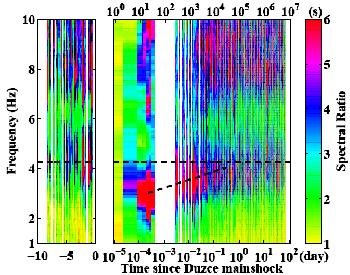
Temporal changes of spectral ratios for the strong motion data at stations VO and FP before and after the occurrence of the 1999 Mw7.1 Duzce, Turkey, earthquake [Wu et al., GJI, 2009]. 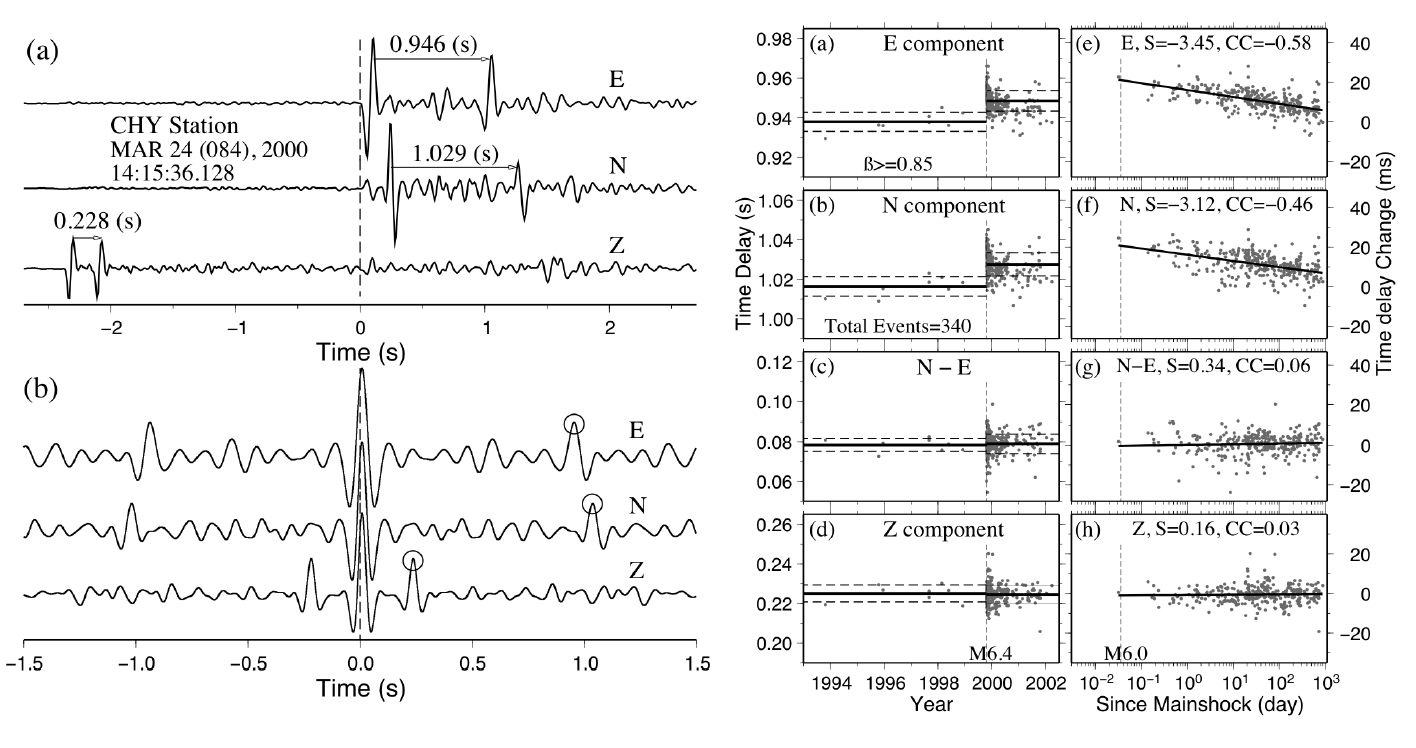
(Left) An example showing surface reflected waves recorded at the borehole station CHY. (Right) Temporal changes of time delays for each component versus the occurrence time before and after the 1999 M6.4 Chia-Yi earthquake [Chao and Peng, GJI, submitted]. |
Global search of non-volcanic tremorNon-volcanic tremor (NVT) is a seismic signal with long durations and no clear body wave arrivals, and with spectra depleted in high-frequency energy compared with regular earthquakes of similar amplitude. NVT was originally identified in a subduction zone southwest of Japan, and subsequently found along the circum-Pacific subduction zones and around the Parkfield section of the San Andreas fault. The tremor is often found during episodic slow-slip events, and together they are called as Episodic Tremor and Slip (ETS).Recent studies by our group and others have found that in addition to occurring in protracted ETS episodes, NVT along the San Andreas fault system in California [ Gomberg et al., Science, 2008 ; Peng et al., GRL, 2008 ; Peng et al., JGR, submitted; Ghosh et al., JGR, submitted], and beneath the central range in Taiwan [ Peng and Chao, GJI, 2008; Chao and Peng, in prep] can be triggered during the passage of surface waves of large teleseismic events. A general emerging feature from these studies is that dynamic stresses on the order of a few to a few tens of KPa are sufficient to trigger NVT. Because the lithostatic stresses at the depth where tremor occurs are several orders of magnitude larger than the stresses associated with teleseismic waves, it is hypothesized that the existence of near-lithostatic fluid pressure could significantly reduce the effective stresses and hence make tremor more susceptible to those subtle external forcing than regular earthquakes. Hence, NVT signals provide an exciting new tool for tracking the aseismic process that may be important for better understanding of loading and releasing of tectonic stresses, earthquake nucleation, and physical basis of earthquake predicibility. 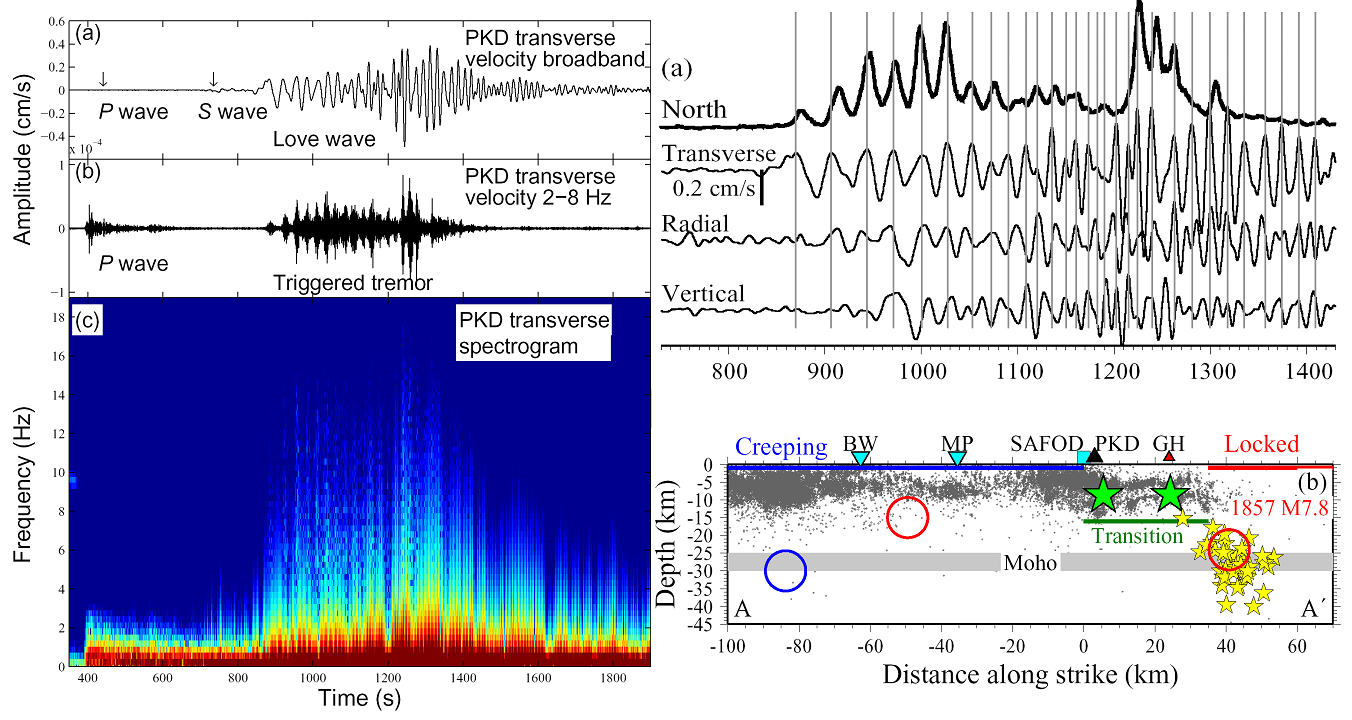
Nov-volcanic tremor around the Parkfield section of the San Andreas fault triggered by the surface waves of the 2002 Mw7.8 Denali Fault earthquake [Peng et al., GRL, 2008]. 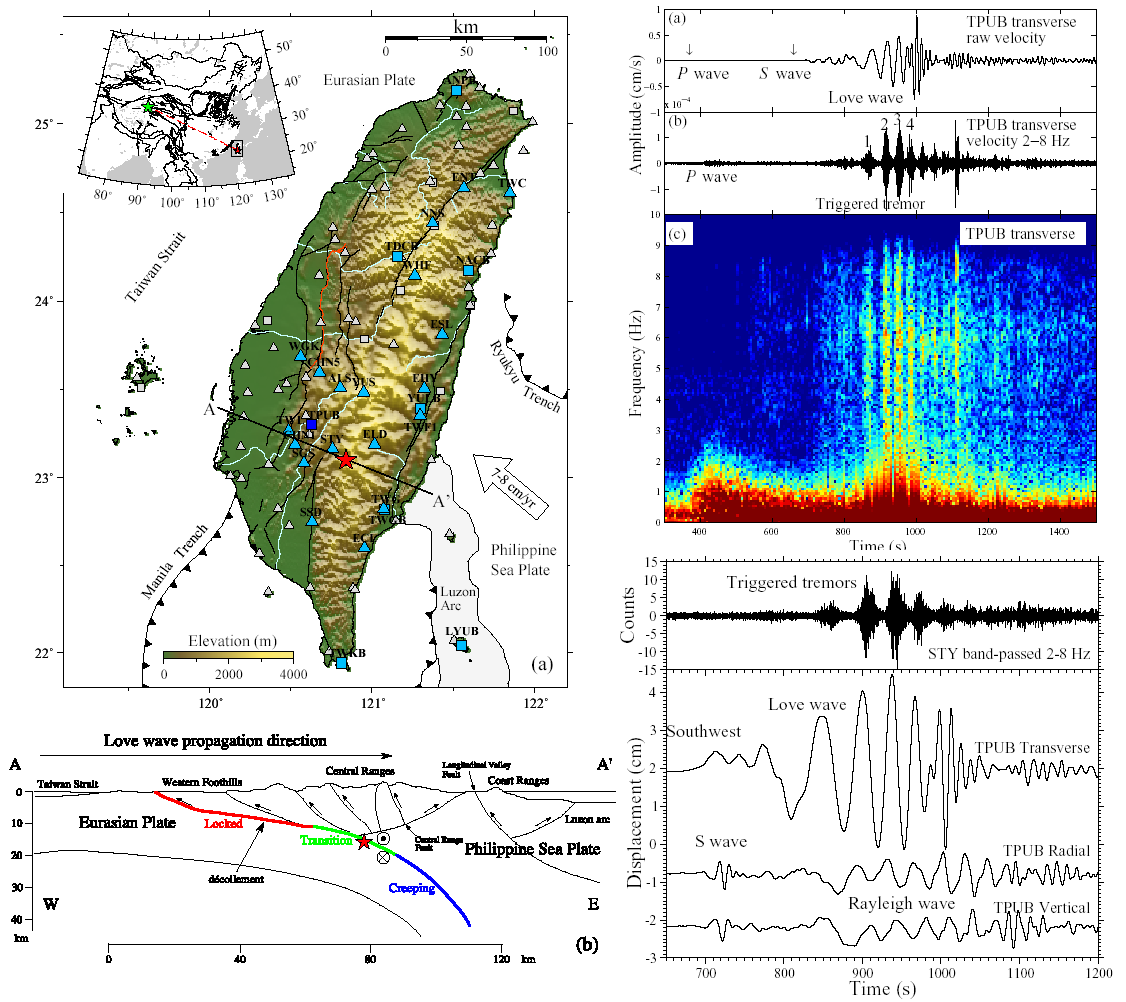
Nov-volcanic tremor beneath the central Range in Taiwan triggered by the surface waves of the 2001 Mw7.8 Kunlun earthquake [Peng and Chao, GJI, 2008]. |
Systematic analysis of early aftershocksLarge shallow earthquakes are typically followed by increased seismic activity, known as “aftershocks”, which diminish in rate approximately as the inverse of the elapsed time since the mainshock. Early aftershocks are earthquakes that occurred immediately after a mainshock, when the seismicity rate is extremely high. However, detection and identification of early aftershocks have often proven to be difficult, mainly due to masking of coda waves from the mainshock and large aftershocks, and overlapping seismic arrivals generated by near simultaneously occurred aftershocks. Our previous studies based on high-pass-filtering of continuous waveforms in Japan [ Peng et al., JGR, 2007] and around the Parkfield section of the San Andreas fault [ Peng et al., GRL, 2006 ] have found that a significant portion of the aftershocks are missing in the regular catalog in the first few hours after the mainshock. It often takes a certain period of time (typically 1-2 days) to accumulate enough located aftershocks that can be used to delineate mainshock rupture area. Such time delay makes it impractical to use early aftershocks to identify the primary fault plane and rupture propagation direction in near real time.
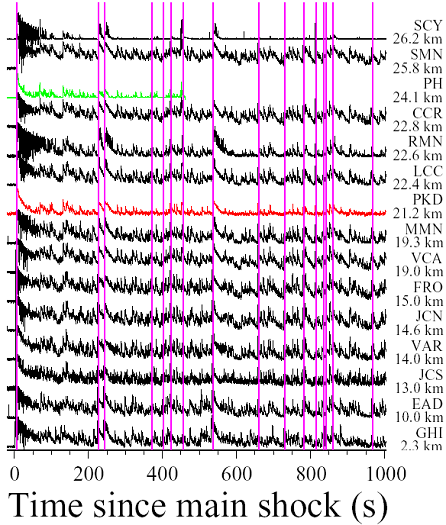
Envelope functions of high-pass-filtered continuous seismic recordings significant missing of aftershocks immediately after the 2004 Mw6.0 Parkfield earthquake [Peng et al., GRL, 2006]. 
The occurrence time versus the along-strike distance showing the migration of aftershocks immediately after the 2004 Parkfield mainshock [Peng, in prep]. In addition, we plan to apply this technique to study early aftershocks of other recent large earthquakes. The systematic identification of early aftershocks for these large earthquakes could provide valuable information on the mainshock slip distribution and relaxation processes after the mainshock. Such technique could also be implemented in near real time to provide rapid estimation of the mainshock rupture area and directivity effects, which are critical for rapid assessment of the damage and societal impact generated by the large earthquakes. |
Inner core scattering and rotationRecent observations of inner-core scattered (ICS) waves provide clear evidence that the outermost 300 km of the inner core contains strong heterogeneity with a length scale of a few kms [ Vidale and Earle, Nature, 2000 ; Koper et al., EPSL, 2004 ]. These waves follow a similar path to the inner-core reflected waves PKiKP, and were originally observed in the seismic data produced by 16 events in the distance range of 58 and 73 deg recorded by the Large Aperture Seismic Array (LASA). Together with Professor John Vidale , Professor Keith Koper and his former student Felipe Leyton, we find additional evidence of the ICS waves using a total of 78 events recorded by the LASA and in the distance range from 18 to 98 deg [ Peng et al., JGR, 2008] . We use the Generic Array Processing software package to identify these waves based on travel time, back azimuth, ray parameters, amplitude, and coherence. A total of 44 events generated clear ICS waves. Most of them appear without the parent PKiKP phase, initially grow in time, and have a spindle-shaped envelope. The duration, rise time, and decay rates of the observed ICS waves can be best explained by small-scale volumetric heterogeneities in the outermost few hundred kms of the inner core. Most ICS waves are found for ray paths sampling the Pacific Ocean and Asia, and relatively few observations from the Atlantic Ocean, consistent with a hemispheric pattern of the inner core structure. The average Qc values is ~600. Our results indicate that systematic analysis of ICS waves provides important constraints on the fine-scale heterogeneity and temporal changes of the inner core structure. |
zhigang.peng@eas.gatech.edu. Last updated Mon Jan 5 16:11:15 EST 2009