|
News:
11/14/10:
| Geophysics faculty member Joe Dufek
was announced as the 2010 Hishashi Kuno Early Career Scientist Award from AGU's Volcanology, Geochemistry, Petrology Section. "The Hisashi Kuno Award recognizes the scientific accomplishments of junior scientists who make outstanding contributions to the fields of volcanology geochemistry and petrology. In doing so, the VGP section highlights excellence in research performed during and in the seven years after the awardee's Ph.D studies." For more information, please visit Volcanology, Geochemistry and Petrology Section Awards . Congratulations Joe!
|
04/27/10:
Geophysics faculty member Zhigang Peng
was announced as the 2010 Charles. F. Richter Early Career Award Recipient by the Seismological Society of America.
``The Charles F. Richter Early Career Award honors outstanding contributions to the goals of the Society by a member early in her or his career. No more than one Richter Award may be given each calendar year. The Richter award is presented at the annual meeting following the year of the award. ''
Please visit The SSA website and the SRL website for more informaiton.
Congratulations Zhigang!
|
12/01/09:
Geophysics faculty member Zhigang Peng
and graduate studnt Peng Zhao
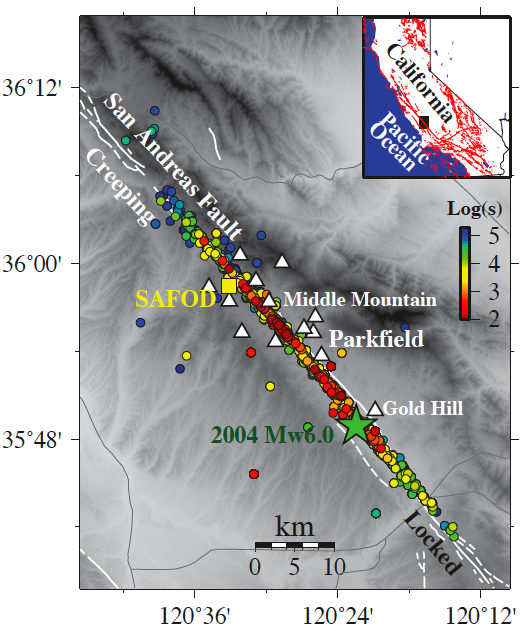
recently published a paper in Nature Geoscience on migration of early aftershocks after the 2004 Mw6.0
Parkfield earthquake on the San Andreas Fault. Using existing waveforms as match filter, we have detected
up to 11 times more aftershocks in the first two days after the 2004 Parkfield earthquake. The newly detected
aftershocks appear to migrate along the fault strike and down-dip directions, supporting the view that early aftershocks are driven by aseismic creep induced by the mainshock. See below for the news report. The research is supported by the USGS NEHRP program G09AP00114.
Citation: Peng, Z., and P. Zhao (2009), Migration of early aftershocks following the 2004 Parkfield earthquake, Nature Geosci. , 2, 877–881, doi: 10.1038/ngeo697.
[Main Text, login required]
[Supplementary Information]
[GT News Release]
[Xinhua News Release, in Chinese]
|
|
10/13/09:
Recently, PhysOrg.com, a science and technology news website, featured a story on graduate student Chuanfei Dong and others who studied the "Effects of Prediction Feedback on Multi-Route Intelligent Traffic Systems". They examine the dynamics of traffic flow with real-time information and explore the influence of an efficient feedback strategy termed Prediction Feedback Strategy (PFS) on a multi-route scenario in which dynamic information is generated and displayed to guide drivers decision making.
Using a multi-route scenario, the study incorporates the effects of adaptability into the cellular automaton models of traffic flow creating simulations of feedback strategy that demonstrated high efficiency in controlling spatial distribution of traffic patterns compared with to other feedback strategies, including vehicle number and traffic flux
Citation: Dong, Chuan-Fei, Ma Xu, Wang Bing-Hong, and Sun Xiao-Yan. Effects of Prediction Feedback on Multi-Route Intelligent Traffic Systems. arXiv:0909.5202v2.
Dong Chuan-Fei, Ma Xu, Wang Guan-Wen, Sun Xiao-Yan, and Wang Bing-Hong. Prediction feedback in intelligent traffic systems, Physica A 388, 4651-4657, 2009.
[link here]
|
|
9/23/09:
Faculty Position in Solid-Earth Geosciences
The School of Earth and Atmospheric Sciences (EAS) at Georgia Tech invites applications for a faculty position in Solid-Earth Geosciences. Candidates working in the following areas are particularly encouraged to apply: large-scale geodynamics, global seismology, earth surface processes, solid-earth geochemistry, planetary geosciences, remote sensing, and geologic hazards. While outstanding candidates at all levels will be considered, we are especially interested in mid-career and senior scientists that have demonstrated scientific and programmatic leadership. We are seeking candidates who are interested in contributing to an interdisciplinary academic and research environment that includes atmospheric science, climate, oceanography, geochemistry, and geophysics. The School of Earth and Atmospheric Sciences currently has 27 FTE faculty members, 95 graduate students, and 70 undergraduate students and has excellent facilities in the 265,000 square-foot Environmental Science and Technology Building. For more information about our School and programs please visit www.eas.gatech.edu.
Applicants should submit an application letter, curriculum vitae, a statement of research and teaching interests, and the names and contact information for at least three references. Application materials should be submitted electronically as pdf files to susan.ryan eas.gatech.edu. Requests for information should be directed to Dr. Zhigang Peng, zpenggatech.edu, (404) 894-0231. eas.gatech.edu. Requests for information should be directed to Dr. Zhigang Peng, zpenggatech.edu, (404) 894-0231.
Applications will be considered beginning November 30, 2009 but the search will continue until the position is filled. Georgia Tech is a unit of the University System of Georgia and an equal education/employment opportunity institution.
|
9/23/09:
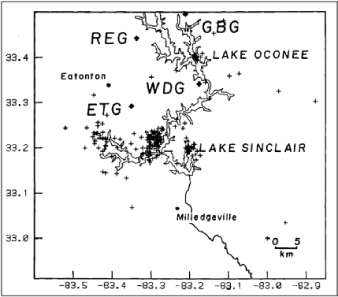
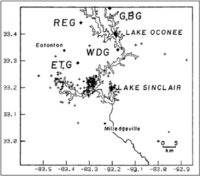
Emeritus Professor L. Tim Long just published a paper on central Georgia Seismicity in the Georgia Geological Society Guidebook. The paper focuses on recent activity and variations in local ground attenuation, with information from the April 4, 2009 Lake Sinclair earthquake (M=3.1).
Citation: Long, L.T, The Central Georgia Seismicity, Georgia Geological Society Guidebook, 29, 65-70, 2009.
[link here]
|
|
8/27/09:
Recent Postdoctoral researcher Ting Chen (Now at Wuhan University, China), graduate student
Lujia Feng, with advisor
Andrew Newman and colleague
Hermann Fritz
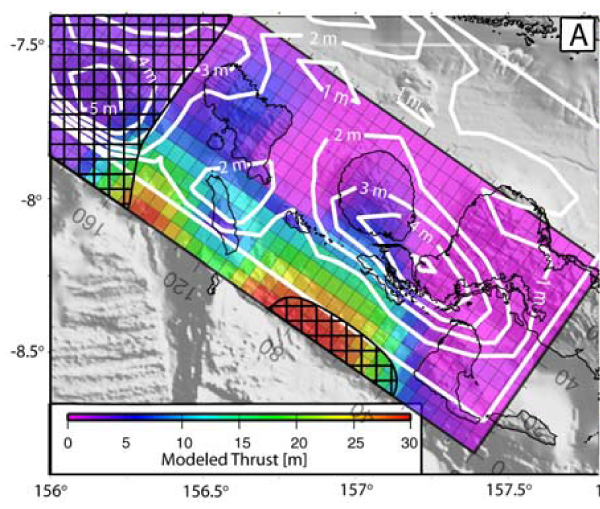
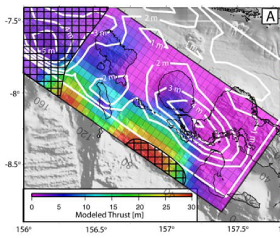
have published a paper in Geophysical Research Letters on the unique and very high shallow slip caused by the
April 1, 2007 moment magnitude (MW 8.1) earthquake in the Solomon Islands. Because of the unique geometry
of the region, land very near, and crossing the trench allowed for unprecedented measurements of the shallowest portion
of the subduction interface. We used exposed corals and coastal subsidence caused by the event to constrain the
combined coseismic and early postseismic deformation from the events nucleation zone. The result is intriguing, as it shows
very high (10+ meters) slip in the shallowest environment, more than any other portion of the rupture. Since tsunami
damage was only moderate in affected regions, it is likely that this slip occurred as early afterslip, rather than coseismic
rupture. Research was supported by Georgia Tech, the Open Research Fund Program, the National Science Foundation (NSF), and the
United Nations Educational, Scientific, and Cultural Organization (UNESCO).
Citation: Chen, T., A. V. Newman, L. Feng, and H. M. Fritz (2009), Slip distribution from the 1 April 2007 Solomon Islands earthquake: A unique image of near-trench rupture, Geophys. Res. Lett., 36, L16307, doi:10.1029/2009GL039496.
[link here]
|
|
7/26/09:
Geophysics faculty member Zhigang Peng
recently published a paper in Journal of Geophysical
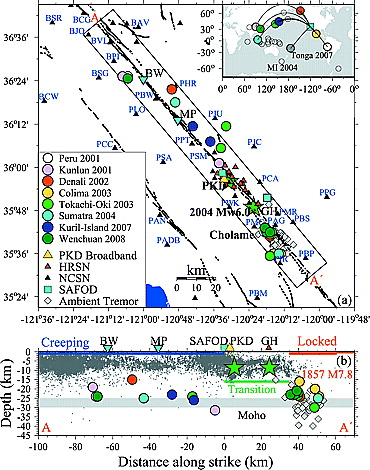
Research on remote triggering of non-volcanic tremor. Through a systematic search of
all events with magnitude greater than 7.5 since 2001, this work found 10 events that have triggered clear
non-volcanic tremor along the San Andreas fault system in Central California. Most tremor was initiated and
in phase with the Love wave particle velocity, although Rayleigh waves and sometimes the teleseismic P waves
also contributed in triggering the tremor activity. The amplitude of the teleseismic waves weakly
correlates with the occurrence of triggered tremor, and the inferred tremor-triggering threshold is ~2-3 KPa. The relatively low triggering threshold indicates that the effective stress at the tremor source region is very low, most likely due to near-lithostatic fluid pressure. This work is done in collaboration with scientists in University of Washington and UC Berkeley, and is supported
by National Science Foundation.
Citation: Peng, Z., J. E. Vidale, A. G. Wech, R. M. Nadeau, and K. C. Creager (2009), Remote triggering of tremor along the San Andreas Fault in central California, J. Geophys. Res. , 114, B00A06, doi:10.1029/2008JB006049.
[link here]
|
|
6/19/09:
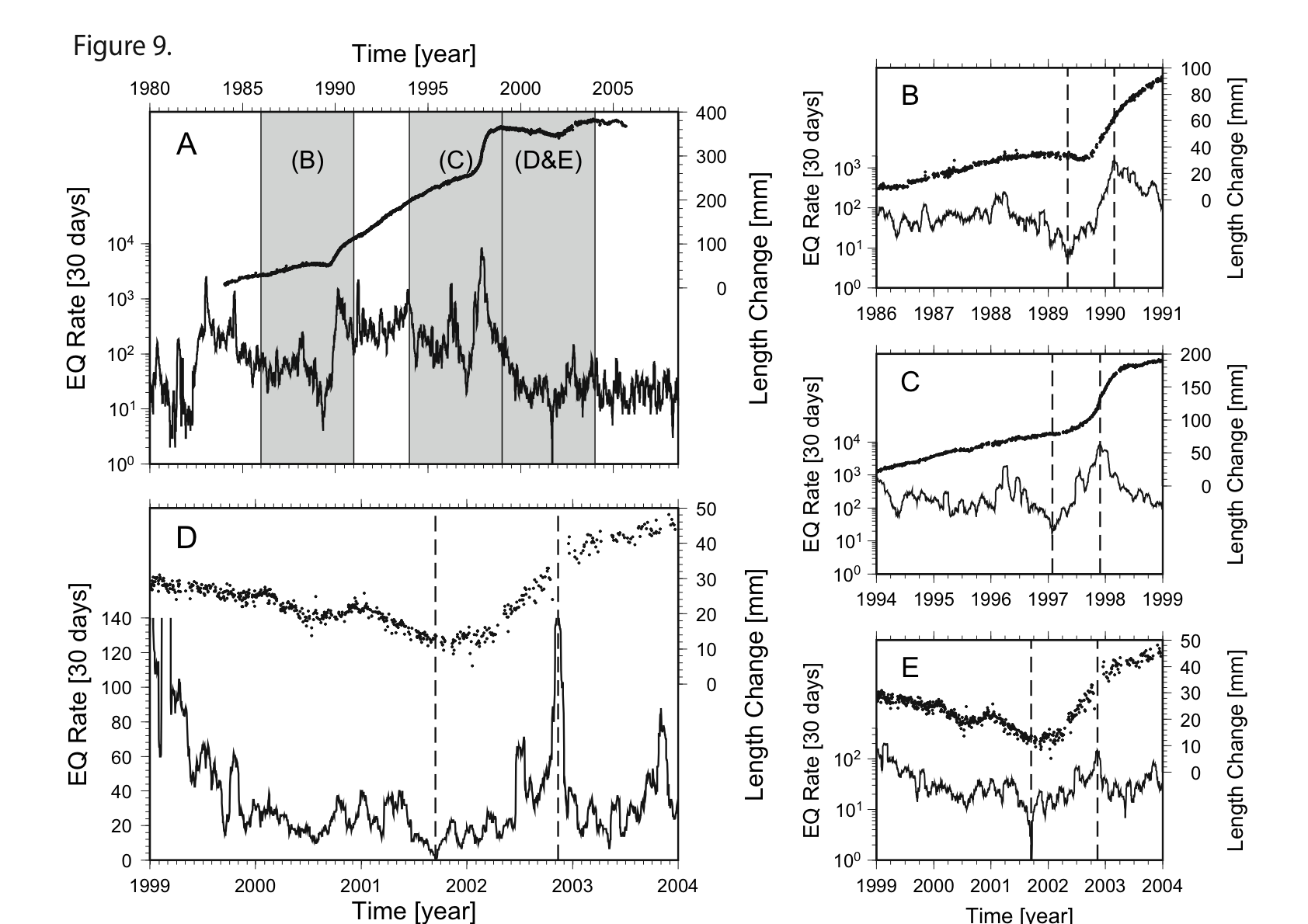
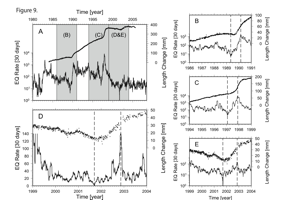
Graduate student Lujia Feng and advisor, Andrew Newman, publish on continued episodic uplift at Long Valley Caldera. Using transient deformation from more than a dozen permanent GPS stations during the latest uplift event, this paper characterizes the elastically-derived location of the primary pressure source. This paper is the first to document Long Valley's ability to dynamically affect stress orientations and extension rates along the adjacent Inyo-Mono volcanic chain, and the first to
identify a significant precursory seismic quiescence before each of the last three uplift episodes.
Citation: Feng, L., and A. V. Newman, Constraints on continued episodic inflation at Long Valley Caldera, based on seismic and geodetic observations, J. Geophys. Res., 114 (B06403), doi:10.1029/2008JB006240, 2009.
[link here]
|
|
4/16/09:
Graduate Students Jeff Hoeft and Ming-Chu Chen were awarded graduate student research grants from the Geological Society of America and Sigma Xi! Jeff's grant from GSA is for his work on extension rates in the eastern California shear zone/Walker Lane and Ming-Chu's grant will help support his research on river incision in western Taiwan.
In addition, Ming-Chu has been awarded an NSF East Asia and Pacific Summer Institute Fellowship and Jeff received a "seed" grant from the National Center for Airborne Laser Mapping for LiDAR data collection in the region affected by the 1886 Charleston, SC earthquake.
1/1/09:
|
web author: A. Newman| Geophysics @ GT | Updated:
Thu Aug 27 06:52:39 EDT 2009
School of Earth & Atmospheric Sciences, Georgia Tech, Atlanta, GA 30332-0340
|