GENERAL
When: August 19 - December 9, 2014
Lecture: Tues., Thurs., 9:35 - 10:55 am -- ES&T L1175
Lab: Fri.,12:05 - 2:55 pm -- ES&T L1116
Office Hours:
Instructors: Mondays 2 - 3 pm, and Thursdays from 2 - 3:30 pm, or by appointment.
Teaching Assistant: Tuesdays 11 am - 12 pm, and Thursdays from 1 - 2 pm, or by appointment.
Course Objectives:
Designed for Earth Science and Engineering majors and graduate students interested in applying
field and theoretical methods to understand the dynamic history and
state of earth's crust. Useful for a wide range of natural and anthropogenic
topics, including: plate tectonics; earthquake occurrence; landscape evolution;
groundwater and petroleum reservoirs; and mineral resources.
We will examine the application of stress
and strain on rocks, the development of faults and folds, orogenic belts and
plate tectonics, basic interpretation of geologic maps, and
field techniques in structural geology (yes, there will be field trips!).
Through laboratory excercises and instruction, students will learn modern computational methods
for characterizing structural geology through MATLAB.
Required Text:
- Fossen, Hakkon, Structural Geology, Cambridge Press, 463 pp., 2010.
- Allmendinger, R. W., N. Cardozo, & D. M. Fisher, Structural Geology Algorithms: Vectors and Tensors, Cambridge Press, 289 pp., 2012.
Class Communications:
You will occasionally receive class information
via email to your prism account. Because this information may not be communicated
in class, it is your responsibility to read all such emails.
In emailing us for class, please add [Structure] to the subject line and
identify yourself by name in the message since not all prism accounts clearly
identify the email's author.
Course Outline:
Please see PDF Syllabus, above.
EVALUATION:
Students enrolled in EAS-4200 will be evaluated independently of those enrolled in EAS-6320.
Those enrolled in EAS-6320 will be required to perform all homework assignments and exams
as students in EAS-4200, as well as additional Laboratory exercises, Field assignments,
and exam questions.
For both the undergraduate and graduate sections, the grade is based on Lab and
Field Exercises (60%), and Exams (40%).
Two Field trips (one Saturday, and one Friday through Sunday) are associated with this class.
Both trips are mandatory. Missing either can severely impact your grade.
ACADEMIC HONESTY:
General: It is expected that all students are aware of their individual
responsibilities under the Georgia Tech Academic Honor Code, which will be
strictly adhered to in this class.
Problem Sets and Projects:
Students are encouraged to work together on developing solutions to problem sets; however, the solutions/answers that are turned in must be the work of each individual. Include the name of individuals consulted for each problem that you sought aid in answering (including instructors). Any write-up of laboratory or field reports, should however be the work of the individual student, thus for this work there should be no copying from others in class. Finally, at any point in which you are using material you’ve referenced from another source, it is your obligation to appropriately reference that source. Plagiarism is strictly forbidden.
Plagiarism
is the act of appropriating the literary composition
of another, or parts of passages of his or her writings,
or language or ideas of the same, and passing them off as
the product of one's own mind. It involves the deliberate
use of any outside source without proper acknowledgment
(as defined by the
Georgia Tech Academic Honor Code).
Exams: All information required for exams will be supplied. Reference
to texts or other documents during exams is strictly forbidden. The use of
electronic devices (e.g. cellular phones, computers etc.) other than
non-programmable calculators during exams and quizzes is not allowed.
|
Geophysics Home | anewman gatech.edu, and ken.ferrier gatech.edu, and ken.ferrier eas.gatech.edu | Updated:
Tue Aug 12 11:30:42 EDT 2014 eas.gatech.edu | Updated:
Tue Aug 12 11:30:42 EDT 2014
|
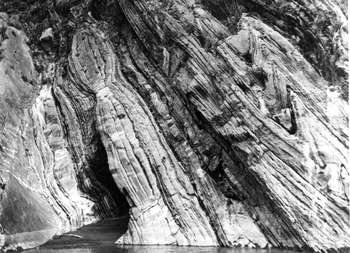 Ductile deformation of the El Doctor Limestone in Queretaro, Mexico, taken by K. Segerstrom, USGS (photo